How Voicebot works
An agent ties a published scenario to a phone number: inbound callers reach it by dialling the number, and automations give it contacts to call.
How the parts connect
Section titled “How the parts connect”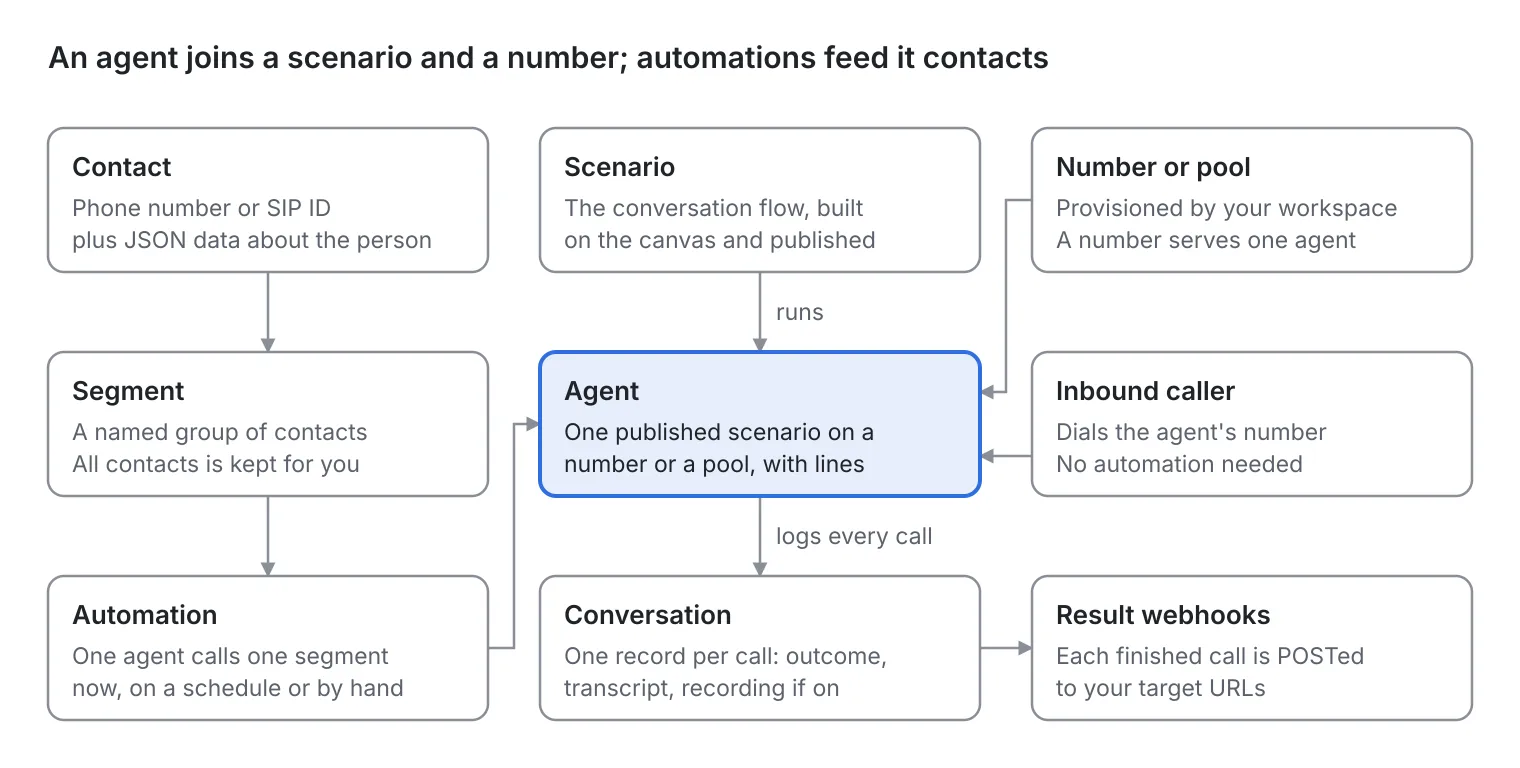
Inbound, a caller dials the agent’s number and the scenario starts on its Inbound call branch. Outbound, an automation hands the agent a segment and the scenario starts on its Outbound call branch. Every call becomes a conversation, and its result can be posted to your systems.
| Part | What it is | Page |
|---|---|---|
| Contact | A phone number or SIP identifier plus data about the person | Contacts and segments |
| Segment | A named group of contacts that an agent calls as one | Contacts and segments |
| Automation | One agent calling one segment, now or in scheduled windows | Automations |
| Scenario | The conversation flow, built from bricks and published as a version | Scenario builder |
| Agent | One published scenario on one number or a number pool, with a set of lines | Agents |
| Number | A dialable identity of the account, provisioned by your workspace | Phone numbers |
| Conversation | The record of one call: outcome, recording, transcript, variables | Conversations |
| Result webhook | Each finished call posted to a URL you choose | Result webhooks |
What happens during a call
Section titled “What happens during a call”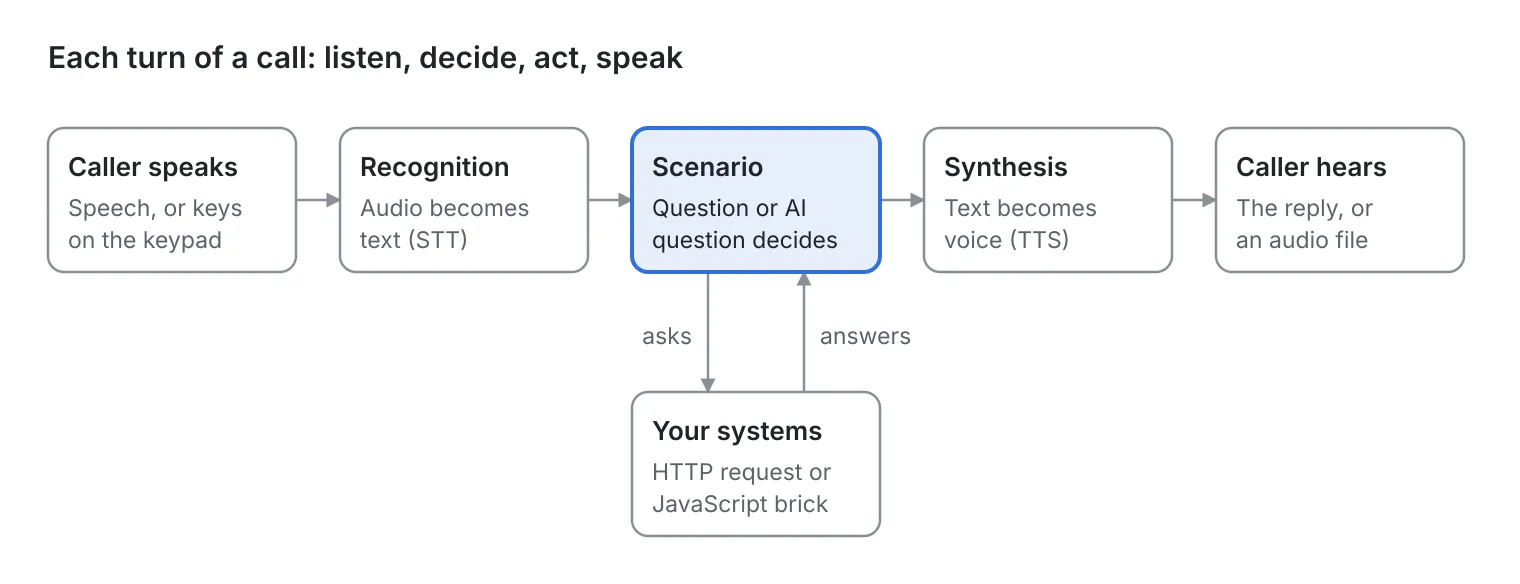
The turn repeats until the scenario reaches End scenario or hands the call to a person. The platform keeps the transcript, every recognised answer, every variable set and, when call recording is on, the recording, and shows them on the conversation.
Numbers and trunks
Section titled “Numbers and trunks”A number is a record saying that a dialable identifier belongs to your account; a trunk is the SIP path to your carrier. Numbers are provisioned by your workspace and shown read-only in the console. Without a working trunk nothing dials, even when numbers are listed.